

Tips for Navigating Grief on Mother’s and Father’s Days

The second Sunday in May often brings special brunches and time spent honoring moms on Mother’s Day. A few weeks later, families gather again as dads take center stage for Father’s Day. These occasions are meant to celebrate parents and strengthen family connections.
For those who have experienced the death of a parent or a child, however, these days can be especially difficult. While many are celebrating, grieving children and parents may feel the weight of their loss more deeply. Following the death of their son, Brandon Shane, in 2021, his mom, Valerie, shared that it was hard to want to celebrate.
“Father’s Day was just a few weeks after his death. How could I celebrate something when my heart was just broken? It was completely broken,” said Valerie, who now serves as a volunteer at Lost & Found.
Approaching this season of celebration with a new reality often means adjusting expectations.
“All holidays can be grief activators for anyone who has experienced the death of a loved one,” said Melanie Blair, assistant executive director of Lost & Found Grief Center. “The key to navigating those difficult days is to practice self-care and, when possible, create new traditions.”
Lost & Found Grief Center offers the following tips for coping with Mother’s and Father’s Day while grieving:
• Manage expectations. It’s okay to opt out of celebrations this year if that feels best for you.
• Set boundaries. Communicate with family and friends about what you can and cannot handle. If you can only participate in part of a traditional gathering, that is enough.
• Recognize your grief activators. Be mindful of situations that may intensify your grief and give yourself permission to avoid them.
• Create new ways to remember. Honor your loved one by making their favorite meal, creating something meaningful, or lighting a candle in their memory.
• Give yourself grace. These holidays are just dates on the calendar. You can connect with loved ones at another time when you feel ready.
Lost & Found Grief Center provides therapeutic grief support groups at no cost to the families it serves. For more information, call (417) 865-9998 or visit www.lostandfoundozarks.com.
Photo caption: Families gather at the closing circle at Lost & Found Grief Center after a night of family grief groups.
Contact:
Mark Miller, Lost & Found Grief Center, Executive Director
mmiller@lostandfoundozarks.com


The Loss of a Brother & a Best Friend
When I was 17, my older brother Luke died from complications of epilepsy.
His death was sudden and unexpected. He was only 20 years old. I watched my parents, once so steady and reliable, disintegrate into puddles of life's most intense emotions. Within months, I became unwillingly familiar with the truth that “there is nothing worse than losing a child.”
Thankfully, my family was surrounded by a close-knit, loving community, and I watched from behind a quiet, stunned exterior as friends and family rushed to my parents’ aid. For a month, maybe more, we never had to lift a finger to prepare dinner. The meal train was so swiftly arranged that I assumed such things just appeared naturally in the wake of a tragic death, just like the texts, the confusion, and the tears.
Of course, I benefited from this support as well, but my hyper-sensitive adolescent awareness could not shake the pesky feeling that all of these well-wishers seemed keenly focused on the tragedy my parents had endured. There were comments, so subtly pronounced that I remember them as whispers, that quickly defined my place within the whirlwind.
“They’re struggling more than you know. Take care of them, now.”
“They need you now more than ever. You better call them every day.”
These well-meaning voices convinced me––distraught and eager to do what I could to help return my parents to the people I knew––that I did not get to feel this loss. That, at least for now, it was theirs, and it was my responsibility to let it be theirs. So, little by little, I retreated into the performance of okay-ness that would stunt my grief for years, left with only the memory of the one person who could’ve helped me – my brother.
As far as I can tell, losing a child really is the worst thing that can happen to someone. I did not build the family that was destroyed by fate’s callous unfolding, nor did I feel the sickening pain of watching the life I created disappear.
But I lost something of my own.
I lost my older brother, my guide, the scout who went three years ahead into the uncertainty of life and reported back with calm conviction that it was all right out there, that some of it even got better. I lost my most reliable companion. I lost the best friend I’ve ever had.
When a child dies, the whole family needs support, not just the parents. I don’t think I was particularly easy to care for as an angsty, self-assured 17-year-old who had bitten off more of his adult confidence than he could gracefully chew, but I don’t think that absolved me of the need for the same softness and support my parents received either.
An adolescent, a kid, who suffers the loss of a sibling not only has grief to deal with, but also the loss of stability in their parents, the loss of their role in their family, and the loss of their entire conception of how life works.
Now, as a volunteer in the teen grief support group at Lost & Found, I get the opportunity to offer what I needed but didn’t know how to ask for: presence, understanding, and hope. Someone to stand with them in the storm.
By helping teenagers learn the language to describe difficult emotions and the tools to process them, I receive more than just a sense of pride or satisfaction upon seeing their well-being improve. For me, helping others through loss has been the next step in the journey none of us choose, but all of us encounter in some form: grief.
- Written by Ethan Miller

James Craig Carr Memorial Scholarship
James Craig Carr Memorial Scholarship
Each year, Lost & Found Grief Center awards the James Craig Carr Memorial scholarship, through the Community Foundation of the Ozarks, to one former grief group participant attending college.
The 2025-2026 scholarship went to Nixa High School graduate Izzy Lord. She is a freshman at Missouri State University.

Izzy first attended Lost & Found with her family in 2018 after her 15-year-old brother Daniel died. Like many young participants, she did not want to attend grief group, but, despite her reluctance on that first night, she now says she found it beneficial.
“Being in group helps you know that you’re not alone,” Izzy said.
After her initial night at Lost & Found, Izzy began looking forward to attending. She said the group coordinators made it fun, and she enjoyed talking about her brother.
“I think the most important thing for a family who has experienced a death is to not let the memories of your loved ones die out.”
“When people ask about my siblings, I say I have four sisters and a brother. If they ask about Daniel, I tell them that he died when he was 15. I put myself in a vulnerable situation to honor him, because people deserve to know he existed,” she shared.
The James Craig Carr Memorial Scholarship opportunity supports current and former participants of Lost & Found Grief Center who are pursuing further education—whether through undergraduate or graduate programs, technical schools, or non-traditional academic paths.
Our partnership with the Carr family and the Community Foundation of the Ozarks is another way we support grieving families.
Applications for the 2026-27 school year open on Jan. 1, 2026.
How to apply:
• Go to the Community Foundation of the Ozarks website.
• Find the criteria by searching “James Craig Carr Memorial Scholarship.”
• When you are ready, click Apply Now to begin the process.
Note: The deadline to submit your application for the 2026-2027 year is March 16, 2026.

Holiday Grief Tips from Lost & Found
For people who are grieving the death of a loved one, the loss can feel the most profound during the holidays. Family traditions and times of celebration are far different without that key family member.
Lost & Found Grief Center offers practical tips for families and individuals who are missing a loved one during this holiday season.
Lost & Found’s Holiday Grief Booklet includes guidance such as:
- Take care of yourself – Grief is physically and emotionally exhausting. It’s not selfish to rest or put yourself first.
- Set realistic expectations – Let go of “how it used to be” and embrace what this year can look like.
- Anticipate grief triggers – The holidays bring expectations to be full of holiday cheer. If that could trigger a grief burst, avoid those situations.
Do not feel obligated to continue family traditions if honoring those traditions could become a grief trigger. Consider creating new traditions such as:
- Prepare a holiday dish, dessert, or drink in your loved one’s honor.
- Create a memory box. You can ask others to write holiday memories, wrap the box, and decide when to open it.
- Purchase a gift your loved one would have liked and give it to a charity or make a donation in your loved one’s name.
“At Lost & Found, we tell our participants to give themselves grace, and that is most important around the holidays,” said Melanie Blair, assistant executive director at Lost & Found. “Do what you can do with family and friends, but it’s okay to pause traditions or start new ones. Grief doesn’t take time off at the holidays, but neither does hope.”
The Holiday Grief Booklet may be viewed online here.
To learn more about Lost & Found Grief Center’s services, visit www.lostandfoundozarks.com or call 417‑865‑9998.
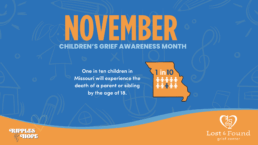
Lost & Found Grief Center recognizes Children's Grief Awareness Month in November by sending out "Ripples of Hope"
This November, in recognition of Children's Grief Awareness Month, Lost & Found Grief Center is raising awareness about the needs of grieving children and spreading ripples of hope through kindness and thoughtful support.
According to the JAG Institute's 2025 Childhood Bereavement Estimation Model, 1 in 11 children—about 6.4 million nationwide—will lose a parent or sibling before the age of 18. In Missouri, the rate is higher: 1 in 10. These sobering statistics underscore the urgent need to recognize and respond to children's grief.
"Like a stone cast into water that creates a ripple; we witness ripples of hope at Lost & Found weekly as kids (and parents) realize they are not alone in their grief," said Mark Miller, executive director of Lost & Found Grief Center. "Children mourning the death of a parent meet other kids experiencing similar losses and build community. After 25 years of serving grieving families, we are now seeing once-grieving children and parents return to Lost & Found to volunteer, serve on our boards, or join our staff. The positive impact of grief support is exponential."
Adults can send a ripple of hope to grieving children in their lives by:
- Actively listening.
- Using clear, concrete, age-appropriate language.
- Validating their feelings.
- Being honest and telling the truth in appropriate ways.
- Consistently showing up for them.
- Providing them with opportunities to express their grief.
- Modeling healthy grieving.
Throughout November, Lost & Found will share stories of the children and families who have benefited from their professional therapeutic grief support services. All Lost & Found grief groups are no cost to the families they serve, but the impact on those who experience grief support is priceless. After receiving grief services at Lost & Found:
- 81% of children knew how to express "big grief feelings."
- 86% of teens found a way to carry their grief and move forward in life.
- 94% of parents were better equipped to navigate their grief.
On Thursdays throughout November, Lost & Found invites the public to wear blue to shine a light on the brave children and families in the community who are learning to heal after loss. Together, Lost & Found and its supporters can show grieving children and parents that they are seen, supported, and never alone.
For a full rundown of ways to commemorate Children's Grief Awareness Month, visit our Children's Grief Awareness page.
For more information on Children's Grief Awareness Month, view this report on Childhood bereavement.
###
Contact: Mark Miller, Lost and Found Grief Center executive director, (417) 839-2886, mmiller@lostandfoundozarks.com
About Lost & Found Grief Center: Founded in 2000, Lost & Found Grief Center strives to improve lives in the community by providing help, hope, and healing through professional grief support services. The Lost & Found Grief Center works with those who are suffering to provide education and support as they face life without their deceased loved one.

Why I Still Take Time Off for Grief (Six Years Later)
With the time-off request page open, I hesitated. Do I really need this day off? After all, it’s been six years.
Six years ago, on September 30, my husband of 17 years died. This date remains a marker of loss, heartache, and change. On the first anniversary, I knew I needed to step away from work. I spent the day kayaking in nature before gathering with friends to honor my late husband, Josh. Since then, I’ve taken this day each year to pause and reflect.
This choice is intentional. This loss was—and still is—significant. It’s not just another date on the calendar. Last year, I wondered if the fifth anniversary might be the last time I’d take the day, but as this one approached, I realized I still needed the mental and emotional space for my grief journey. I needed the mental health day—even if it pains my GenX self to admit it.
As the marketing coordinator for Lost & Found Grief Center, I am fortunate to work in a place that acknowledges grief every day. Yet even here, I questioned myself: Do I really need this day? The encouraging part was that my coworkers and boss not only approved my request but also affirmed it. Their support mattered more than I expected.
Grief is complex, and in the workplace, it becomes even more complicated. We all know our personal lives affect our jobs, but we often try to keep them separate. Over the years, while working for three different organizations, I’ve experienced both deep support and quiet neglect. Those contrasts bring me to a truth we often share at Lost & Found: there is no timeline for grief.
The emotions of loss don’t expire. Year six can be as painful as year two. That’s why it matters so much how workplaces respond. Compassion, flexibility, and understanding aren’t just “nice to have” — they’re essential.
From my perspective, as both a grieving spouse and an employee, here’s what I wish every employer knew:
- Be present. When a grief event strikes, ask if the employee wants to work and to what degree. Some need distraction; others need rest.
- Be understanding & flexible. Your employee may not be operating at 100%. Their mind and attention are clouded with emotions.
- Allow space. If someone needs time on an anniversary or significant date, let them take it—without judgment.
- Accept emotions. Tears or bursts of emotion may surface in meetings. Allow it without shame.
- Be honest. Don’t make decisions behind a grieving employee’s back. If focus remains a struggle, connect them with support resources (i.e., Lost & Found Grief Center) before making quick or long-term decisions.
There is no finish line for grief. What can be found, however, is understanding and patience. When workplaces provide that, they not only honor the humanity of their employees but also build a culture of trust and care—something every organization needs.
I can attest that taking a day for a short pause did lead to more focus on my return and continued healing within my ongoing grief work.
*Pictured above: Jennifer and her late husband, Josh, in the fall of 2018.

Giving Tuesday 2024
For Giving Tuesday 2024, we set a goal of raising $15,000 in donations. Thanks to the incredible support from our community, we surpassed this goal. The final amount received for Giving Tuesday was $32,738.
We are especially grateful to our matching partners: Auxan Capital Advisors, ESC Incorporated, One More Benefit – donating in loving memory of Landon Potts, and State Bank of Southwest Missouri. Additionally, the employee-owners of SRC Holdings Corporation contributed to our Giving Tuesday efforts.
All donations we receive help support Lost & Found Grief Center as we provide help, hope, and healing for grieving families. Lost and Found Grief Center offers therapeutic grief support groups and workshops at no cost to participants. This is made possible by our generous donors and the community that recognizes the challenging nature of grief. Thank you for your continued support!
If you are interested in making a year-end gift, you can do so on our donation page.