

Holiday Grief Tips from Lost & Found
For people who are grieving the death of a loved one, the loss can feel the most profound during the holidays. Family traditions and times of celebration are far different without that key family member.
Lost & Found Grief Center offers practical tips for families and individuals who are missing a loved one during this holiday season.
Lost & Found’s Holiday Grief Booklet includes guidance such as:
- Take care of yourself – Grief is physically and emotionally exhausting. It’s not selfish to rest or put yourself first.
- Set realistic expectations – Let go of “how it used to be” and embrace what this year can look like.
- Anticipate grief triggers – The holidays bring expectations to be full of holiday cheer. If that could trigger a grief burst, avoid those situations.
Do not feel obligated to continue family traditions if honoring those traditions could become a grief trigger. Consider creating new traditions such as:
- Prepare a holiday dish, dessert, or drink in your loved one’s honor.
- Create a memory box. You can ask others to write holiday memories, wrap the box, and decide when to open it.
- Purchase a gift your loved one would have liked and give it to a charity or make a donation in your loved one’s name.
“At Lost & Found, we tell our participants to give themselves grace, and that is most important around the holidays,” said Melanie Blair, assistant executive director at Lost & Found. “Do what you can do with family and friends, but it’s okay to pause traditions or start new ones. Grief doesn’t take time off at the holidays, but neither does hope.”
The Holiday Grief Booklet may be viewed online here.
To learn more about Lost & Found Grief Center’s services, visit www.lostandfoundozarks.com or call 417‑865‑9998.

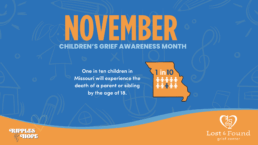
Lost & Found Grief Center recognizes Children's Grief Awareness Month in November by sending out "Ripples of Hope"
This November, in recognition of Children's Grief Awareness Month, Lost & Found Grief Center is raising awareness about the needs of grieving children and spreading ripples of hope through kindness and thoughtful support.
According to the JAG Institute's 2025 Childhood Bereavement Estimation Model, 1 in 11 children—about 6.4 million nationwide—will lose a parent or sibling before the age of 18. In Missouri, the rate is higher: 1 in 10. These sobering statistics underscore the urgent need to recognize and respond to children's grief.
"Like a stone cast into water that creates a ripple; we witness ripples of hope at Lost & Found weekly as kids (and parents) realize they are not alone in their grief," said Mark Miller, executive director of Lost & Found Grief Center. "Children mourning the death of a parent meet other kids experiencing similar losses and build community. After 25 years of serving grieving families, we are now seeing once-grieving children and parents return to Lost & Found to volunteer, serve on our boards, or join our staff. The positive impact of grief support is exponential."
Adults can send a ripple of hope to grieving children in their lives by:
- Actively listening.
- Using clear, concrete, age-appropriate language.
- Validating their feelings.
- Being honest and telling the truth in appropriate ways.
- Consistently showing up for them.
- Providing them with opportunities to express their grief.
- Modeling healthy grieving.
Throughout November, Lost & Found will share stories of the children and families who have benefited from their professional therapeutic grief support services. All Lost & Found grief groups are no cost to the families they serve, but the impact on those who experience grief support is priceless. After receiving grief services at Lost & Found:
- 81% of children knew how to express "big grief feelings."
- 86% of teens found a way to carry their grief and move forward in life.
- 94% of parents were better equipped to navigate their grief.
On Thursdays throughout November, Lost & Found invites the public to wear blue to shine a light on the brave children and families in the community who are learning to heal after loss. Together, Lost & Found and its supporters can show grieving children and parents that they are seen, supported, and never alone.
For a full rundown of ways to commemorate Children's Grief Awareness Month, visit our Children's Grief Awareness page.
For more information on Children's Grief Awareness Month, view this report on Childhood bereavement.
###
Contact: Mark Miller, Lost and Found Grief Center executive director, (417) 839-2886, mmiller@lostandfoundozarks.com
About Lost & Found Grief Center: Founded in 2000, Lost & Found Grief Center strives to improve lives in the community by providing help, hope, and healing through professional grief support services. The Lost & Found Grief Center works with those who are suffering to provide education and support as they face life without their deceased loved one.

Why I Still Take Time Off for Grief (Six Years Later)
With the time-off request page open, I hesitated. Do I really need this day off? After all, it’s been six years.
Six years ago, on September 30, my husband of 17 years died. This date remains a marker of loss, heartache, and change. On the first anniversary, I knew I needed to step away from work. I spent the day kayaking in nature before gathering with friends to honor my late husband, Josh. Since then, I’ve taken this day each year to pause and reflect.
This choice is intentional. This loss was—and still is—significant. It’s not just another date on the calendar. Last year, I wondered if the fifth anniversary might be the last time I’d take the day, but as this one approached, I realized I still needed the mental and emotional space for my grief journey. I needed the mental health day—even if it pains my GenX self to admit it.
As the marketing coordinator for Lost & Found Grief Center, I am fortunate to work in a place that acknowledges grief every day. Yet even here, I questioned myself: Do I really need this day? The encouraging part was that my coworkers and boss not only approved my request but also affirmed it. Their support mattered more than I expected.
Grief is complex, and in the workplace, it becomes even more complicated. We all know our personal lives affect our jobs, but we often try to keep them separate. Over the years, while working for three different organizations, I’ve experienced both deep support and quiet neglect. Those contrasts bring me to a truth we often share at Lost & Found: there is no timeline for grief.
The emotions of loss don’t expire. Year six can be as painful as year two. That’s why it matters so much how workplaces respond. Compassion, flexibility, and understanding aren’t just “nice to have” — they’re essential.
From my perspective, as both a grieving spouse and an employee, here’s what I wish every employer knew:
- Be present. When a grief event strikes, ask if the employee wants to work and to what degree. Some need distraction; others need rest.
- Be understanding & flexible. Your employee may not be operating at 100%. Their mind and attention are clouded with emotions.
- Allow space. If someone needs time on an anniversary or significant date, let them take it—without judgment.
- Accept emotions. Tears or bursts of emotion may surface in meetings. Allow it without shame.
- Be honest. Don’t make decisions behind a grieving employee’s back. If focus remains a struggle, connect them with support resources (i.e., Lost & Found Grief Center) before making quick or long-term decisions.
There is no finish line for grief. What can be found, however, is understanding and patience. When workplaces provide that, they not only honor the humanity of their employees but also build a culture of trust and care—something every organization needs.
I can attest that taking a day for a short pause did lead to more focus on my return and continued healing within my ongoing grief work.
*Pictured above: Jennifer and her late husband, Josh, in the fall of 2018.
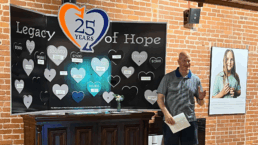
Honor the Past, Shape the future
What does legacy mean to you?
A person’s legacy is the reputation they leave behind with their life's work or example—how they are remembered.
Part of what we do at Lost & Found Grief Center is help grieving individuals and families recall their loved ones’ legacies. Those legacies are not about material wealth or prestige, but about memories – memories that include the everyday fun children have with their parents, such as making cookies with Mom at Christmastime or eating wings with Dad during the Chiefs game.
Through recollection and preserving those memories, grieving children, adults, and families find help, hope, and healing.
For 25 years, Lost & Found has offered its therapeutic grief support groups at no cost to the families we serve, thanks to the generosity of individuals who want their legacy to support those who are grieving.
As we look ahead to the next 25 years, we invite you to make Lost & Found a part of your legacy. The “Legacy of Hope” wall, which will be displayed prominently at the entrance to our grief center, will honor the people and stories that make our mission possible. Every name inscribed represents not just a donation, but a commitment to ensuring that grieving children, teens, adults, and families have a safe, non-judgmental place to heal.
We invite you to be a part of Lost & Found’s Legacy of Hope and imagine a world where no one has to grieve alone. Donation levels of $5,000, $7500, $10,000, and $20,000, and spaces can be reserved through the end of 2025.
If you would like to contribute, please contact Jamie Fields, Director of Development, at (417) 865-9998 or via email at jfields@lostandfoundozarks.com.


Back-to-School Tips to Help Grieving Children
Back-to-School Trips to Help Grieving Children
The start of a new school year is a time for families to return to routines. After a summer of fun, camps, and a more relaxed pace, students and parents often look forward to the predictable cadence of school.
However, for children who experienced the loss of a parent, caregiver, or sibling the previous year, the start of school brings uncertainty and sadness as they navigate this annual milestone without an important person in their lives.
“It’s essential for teachers, administrators, fellow students, and their parents to understand how hard it is for a child following the loss of a loved one, ” said Melanie Blair, assistant executive director of Lost & Found Grief Center. “Communication is the key. We need to acknowledge the child’s loss and hold space for them during this difficult transition.”
Lost & Found Grief Center offers these tips for parents, caregivers, and teachers to help make that first semester back to school after a significant loss as smooth as possible.
Tips for parents and caregivers:
- Notify your child’s teachers. You want your child’s teacher to be aware of the death. Discuss with your child what they are comfortable sharing, so they feel included in the process. If the death occurred over the summer or a child is going to a new school, they may want to keep the death a secret. Parents should talk to their child about telling their story rather than having it come out in whispers.
- Speak with your child’s school counselor. After a death, children may exhibit changes in behavior: anger, trouble concentrating, isolation, and slipping grades. These changes can be part of normal grief and adjustment, but if they persist, they can be a sign that professional support is needed.
- Make a communication plan. You, your child’s teacher, and your child’s school counselor must communicate in a way that will work for all parties. If you have concerns at home, do not hesitate to update your child’s teacher and counselor so they can be aware and request that they do the same with you.
- Parents should take care of themselves. While self-care may be difficult following a tragic loss, research has shown that how grieving children fare is correlated to how their adult caregivers are doing.
Tips for teachers and counselors:
Teachers should know that even the most seemingly innocent activity can be overwhelming for a grieving student. Something as simple as an essay prompt that asks, “What did you do over the summer?” could inadvertently force a child to re-live the death of a family member.
- Be aware of potential grief prompts and provide additional support and understanding.
- Let students know their response is normal.
- Provide extra individual attention and support.
- Provide alternative assignments.
- Allow extra time for adjustment to new routines.
- Let the student know you understand things are different and challenging for them and invite them to talk to you about their struggles.
- Check in with these students more frequently to show support and encourage them to share their feelings.
- Establish a communication plan with parents and caregivers.
For more information about helping a student return to school following the death of a loved one, please contact Lost & Found Grief Center at (417) 865-9998.


What I've Learned So Far - Reflections from Our Executive Director
This month marks one year since I assumed the leadership reins for Lost & Found Grief Center. I still have plenty to learn, but my first year at Lost & Found was like a graduate-level seminar on grief therapy, the nonprofit world, and leadership.
Here are a few nuggets of knowledge I gathered regarding grief.
- There is more tragedy in society than I ever imagined. Babies die, kids die, young adults die, young moms and dads die, and spouses die. All those things happen far more often than I ever knew before I began working at a grief center. When you encounter someone in the store, at the park, or on the road, you have no idea what is happening in their lives.
- We say, "died by suicide" or "died from suicide." Not "committed suicide" because it assigns blame. By reducing stigma, we can encourage people to talk about the death of their loved one and their ensuing grief.
A few things I've learned working at a nonprofit are:
- "We do the work!" I heard that phrase in my first week. When I asked who we hired to perform some task, a colleague told me, "We do the work!" Since then, I've spread mulch around the building, stood on a table to change ceiling tiles, and got soaked in a rainstorm while walking widows into the building for their grief group under a too-small umbrella. Indeed, we do the work — and it is worthwhile.
- I underestimated the size of my "team." Technically, we have 13 people on the payroll, plus 13 paid coordinators for grief groups. Additionally, we have nearly 30 unpaid facilitators, seven greeters, a 15-member Board, a 13-person Junior Board, over 50 regular volunteers, and numerous donors, event sponsors, and community partners. Lost & Found's success is in the agency of others—meaningful impact requires collaboration.
What I've learned about leadership:
- Get good people in the right positions and let them cook. My outstanding staff brings ideas, energy, and passion to the office. My job is to help them succeed.
- Remember Chesterton's Fence—the idea that before you tear down a fence, you should find out why it was built in the first place. A new leader may be excited to storm in and make sweeping changes, but without any context, that often leads to solutions in search of problems. Take the time to learn and listen.
Entering a new arena of work means discovering new partner organizations. Because of the grief support Lost & Found provides to families of organ and tissue donors, I learned about Mid-America Transplant, the St. Louis—based organ and tissue donor center serving our region. Last year, Mid-America saved nearly 900 lives through organ donations and improved the quality of life for almost 200,000 people through tissue donations.
More than anything, I learned that the lyric, "A smile relieves a heart that grieves," in the Rolling Stones' song "Waiting on a Friend" is true. While Lost & Found cannot take away anyone's pain, we can help them learn to cope with their grief and ensure that they know they are not alone. That process starts with a smile.
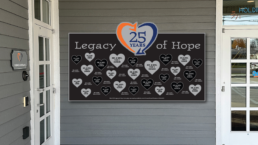
Legacy Wall: Honoring 25 Years of Hope and Healing
In 2025, Lost & Found Grief Center celebrates 25 years of providing help, hope, and healing to grieving families throughout the Ozarks. Since our founding in 2000, we have walked alongside thousands of children, adults, and families during some of life’s most difficult moments.
To commemorate this milestone, we are proud to announce the upcoming installation of our Legacy of Hope Wall—a permanent exhibit that will debut in fall 2025. This custom-designed installation will be placed outside our main entrance. It features heart-shaped placards and spaces engraved with the names of individuals and organizations who are helping shape the next 25 years of our mission.
The Legacy Wall is currently in development, with early commitments from 11 generous donors totaling more than $120,000, including our presenting sponsor Mercy Health Systems. We are especially honored to include the 2025 class of Springfield Business Journal’s Men of the Year, who secured a heart in recognition of their collective support.
We are deeply grateful to Pinnacle Sign Group for their partnership in designing and installing this meaningful tribute.
We look forward to celebrating the partners who have made this possible when we install the 2025 Legacy of Hope Wall this fall.
If you or your organization would like to be a part of the 2025 Legacy of Hope Wall, please contact Jamie Fields, Director of Development, at (417) 865-9998 or email: jfields@lostandfoundozarks.com.
Together, we can ensure that no one grieves alone—now and for generations to come.

A Cherished Donor Honored
April is designated as Donate Life Month, a reminder for me to reflect on the pivotal moment when my husband, Sam, and I made the heart-wrenching decision for our beloved son, Charlie, to become an organ donor. When we received the devastating news that Charlie's condition was beyond further medical intervention and that we were facing the inevitable, we found ourselves confronted with an overwhelming array of decisions that would shape not only our lives but the lives of others.
During our time in the hospital, Sam often spent his days wandering the halls of the hospital, deeply immersed in thought as he grappled with the enormity of his emotions. Meanwhile, I remained at Charlie's side, holding his hand and offering what comfort I could in those final moments. Sam took the lead in navigating all the medical discussions; although I was present during these conversations, the weight of the situation made it difficult for me to fully understand what was being discussed. When the conversation about organ donation arose, Sam first spoke with representatives from Mid-America Transplant and then carefully approached me to share his thoughts. Surprisingly, we both found it to be an easy decision. The notion that something positive could stem from our profound tragedy—a gift that could potentially save lives—offered me a small glimmer of hope amid our heartbreak.
Sadly, Charlie did not die within the necessary time frame for organ harvesting. However, the silver lining in this situation is that Mid-America Transplant still honors him as a donor. This status has always been profoundly important to us, as it reflects the intention and love behind our choice. The medal we received, which honors Charlie's generous gift of life, is a cherished part of his "Box of Interesting Things," a special keepsake that also holds his ashes. I feel incredibly privileged to be a part of this field and to have encountered some of the most compassionate individuals who perform the challenging and sensitive task of approaching families during the most difficult moments of their lives. I deeply appreciate the reverence and respect that each donor family receives, and I am grateful to have gained insight into the vital work done at Mid-America Transplant from both personal and professional perspectives.

Charlie, Luke, and the Boston Marathon
Reflection Post by Mark Miller, Lost & Found Grief Center Executive Director
The third Monday in April is always a big deal for distance running fans – it's the annual running of the Boston Marathon. Among distance runners, the race is known just as “Boston.” As in, “Did you qualify for Boston?” It is also the oldest and most famous of all the marathons in the United States.
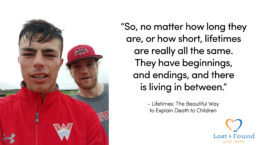
A few people I know have run Boston before. Mostly acquaintances. This year, I was keeping a close eye on bib number 41 – Charlie Sweeney (pictured on the left in the photo next to Luke Miller)
Charlie and my late son Luke were friends and cross-country/track teammates at Western Colorado University. They met each other on their recruiting trip in the fall of 2016 and started college together in 2017.
Luke began having seizures in 2018, leading to an epilepsy diagnosis. He died in January 2019 when he had a seizure in his sleep and suffocated. He was just 20 years old.
I continued to follow Charlie’s running career and that of Luke’s Western teammates. I watched Charlie and the Mountaineers run at the NCAA Division II Indoor Track Championships in March of 2019 in Pittsburg, Kansas. Later that fall, I had dinner with Charlie and his parents in Fayetteville, Arkansas, when the Western cross country team competed at the University of Arkansas.
On Boston Marathon Monday 2025, I was thrilled to see Charlie finish 19th with a personal record time of 2:12. That’s 4:57 per mile. Luke and Charlie were comparable athletes and runners. Luke competed for the Western varsity cross country team as a true freshman, and he was on pace to run under 4:10 for the mile.
That’s not to say that Luke would have become a professional marathoner running in Boston. There are many variables that play into the success of a distance runner, including injuries, training response, and just the desire to continue to run 100-plus miles per week. I just don’t know what he could have achieved because he developed epilepsy at 19 and was dead by 20.
When a young person dies, you not only grieve for their life but also their future because it is an unrealized potential.
It was exciting to have someone to cheer on during the 2025 Boston Marathon, and I am thrilled for Charlie. I am also a little melancholy. Luke never had a chance to reach his running potential or achieve his goal to become a film director and screenwriter.
While I grieve what might have been for Luke, I am also grateful for the 20 years we had with him, including the movies and concerts we saw together, the 14,000-foot mountain we climbed in Colorado with his brother and cousin, and our family trips. I am thankful for those memories and knowing that he was loved and had friends.
“So, no matter how long they are, or how short, lifetimes are really all the same. They have beginnings, and endings, and there is living in between.”
From the book Lifetimes: The Beautiful Way to Explain Death to Children by Bryan Mellonie and Robert Ingpen.

Lost & Found Selected as Charity Partner for SBJ Men of the Year
Lost & Found Grief Center is honored to be selected as this year's charity partner for the 15th annual Springfield Business Journal's Men of the Year class. This award recognizes the professional, philanthropic, and civic contributions of 20 businessmen throughout the Springfield region.

"The 2025 Men of the Year honorees, in alphabetical order, are: Mark Applegate, SeniorAge Area Agency on Aging; Dr. Kofi Asare-Bawuah, CoxHealth; Michael Cho, Craft Sushi and Hickory Hills Country Club; Cory Collins, Husch Blackwell LLP; Andy Drennen, Simmons Bank; Lonnie Funk, Rolling Oaks Group of Companies LLC; Stephen Hall, Springfield Public Schools; Colten Harris, City of Springfield; Douglas L. Healy, Healy Law Offices LLC; Brad S. Johnson, College of the Ozarks; Mark Kastner, retired; David Kelly, Nixa Public Schools; Samuel Knox, Unite of Southwest Missouri Inc.; Mark Milioni, Mission University; Dan Patterson, Greene County Prosecuting Attorney’s Office; Philip Rothschild, Missouri State University and Fresh Grounded Faith Events; Dr. Kenneth S. Sharlin, Sharlin Health and Neurology LLC; Joseph D. “Chip” Sheppard III, Carnahan Evans PC; Mark Walker, TransLand; and Kevin Waterland, Pitt Technology Group LLC."
To help celebrate Lost & Found Grief Center's 25th year as an organization, we challenged this group to raise a total of $25,000. Nominees can do this by creating a personalized fundraiser page or by sponsoring an upcoming event. Using a personalized fundraising page, each nominee can add a personal goal, photo, and additional info. Track the progress of each fundraiser, contribute, and see who the top fundraiser is today here. This challenge runs through April 24, when SBJ will host their Men of the Year event. Lost & Found Grief Center's Executive Director will also be a speaker at this event.
Congratulations again to all of this year's Men of the Year honorees.
If you are interested in creating a personalized fundraising page to support Lost & Found, reach out to info@lostandfoundozarks.com for details.
Read the original announcement from the Springfield Business Journal here.
Pictured: This year's honorees at the photo shoot on March 21, 2025.